

If your website traffic suddenly drops or your rankings start declining, there’s a strong possibility that spammy backlinks are affecting your site. Many website owners focus heavily on building backlinks but ignore their quality, which can lead to serious SEO issues over time.
Search engines like Google have evolved significantly. They no longer reward just the quantity of backlinks; instead, they evaluate relevance, authority, and trust. If your site is linked from low-quality or suspicious sources, it can damage your rankings instead of improving them.
In this detailed guide, you’ll learn how to audit and remove spammy backlinks step by step using practical methods. The goal is to help you clean your backlink profile and build a strong SEO foundation.
What Are Spammy Backlinks?
Spammy backlinks are links from low-quality, irrelevant, or manipulative websites that point to your domain. These links are usually created without real value and often violate search engine guidelines.
They typically come from link farms, automated tools, irrelevant blogs, or websites that exist only for linking purposes. In many cases, these links are not built intentionally — they can also be the result of negative SEO.
Instead of helping your rankings, these backlinks send negative signals to search engines, indicating that your site may not be trustworthy.
Why Spammy Backlinks Are Dangerous
Having too many spammy backlinks can harm your website in multiple ways. Search engines may interpret these links as an attempt to manipulate rankings, which can lead to penalties or ranking drops.
A poor backlink profile can reduce your domain authority and make it harder for your pages to rank, even if your content is high quality. In severe cases, manual actions can be applied, causing significant traffic loss.
This is why regular backlink audits are not optional—they are necessary for maintaining long-term SEO performance.
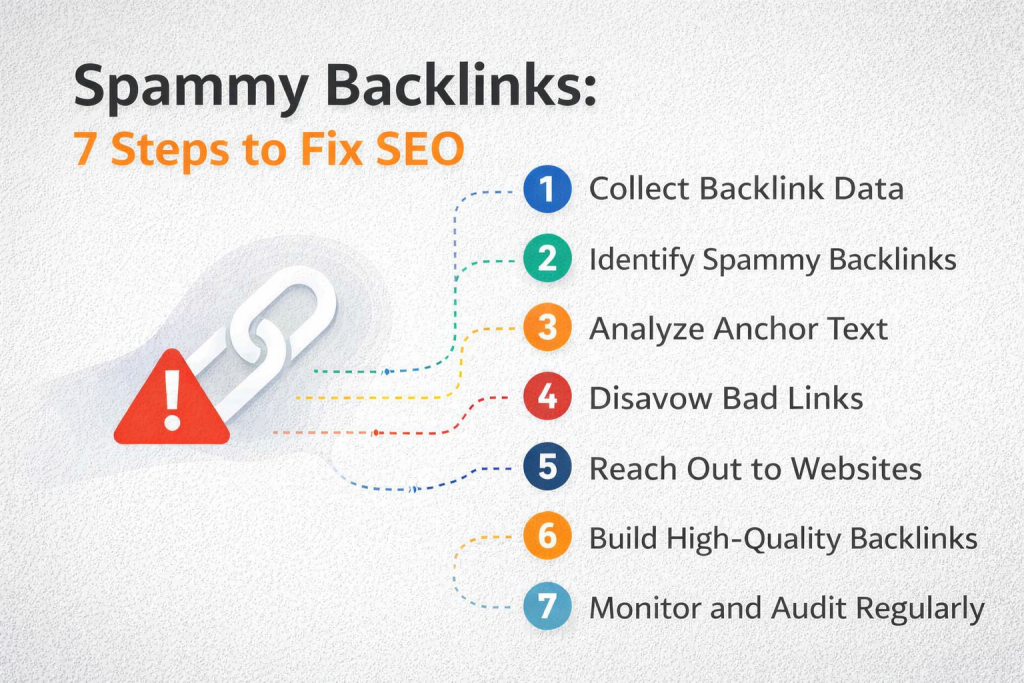
Step 1: Collect Your Backlink Data
Before you can remove spammy backlinks, you need a complete and accurate list of all links pointing to your website.
The best place to start is Google Search Console, which provides a free overview of your backlinks. However, relying on a single tool is not enough. Professional SEO tools like Ahrefs, SEMrush, and Moz can give you deeper insights.
Export your backlink data from multiple sources and combine it into a single spreadsheet. After merging the data, remove duplicate entries so that you’re working with a clean dataset. This step ensures you don’t miss any harmful links during the audit process.
Step 2: Identify Spammy Backlinks
Once you have your data ready, the next step is to identify spammy backlinks. This requires careful evaluation rather than blindly trusting automated scores.
Start by reviewing the linking domains manually. Look at the design, content quality, and overall trustworthiness of each site. If a website appears poorly designed, filled with ads, or contains meaningless content, it is likely a spam source.
You should also consider the relevance of the linking site. For example, if your website is about technology but you are getting links from gambling or adult websites, those links are clearly unnatural.
Here are a few quick signals to watch for:
- Irrelevant niche or industry
- Very low-quality or auto-generated content
- Suspicious domain names
- Pages with excessive outbound links
Understanding link quality becomes easier when you know how links are built, so you can also explore our link building strategies guide.
Step 3: Analyze Anchor Text Distribution
Anchor text analysis is another powerful way to detect spammy backlinks. A natural backlink profile usually contains a mix of branded, generic, and partial-match anchor texts.
If you notice that a large number of links are using the exact same keyword repeatedly, it’s a strong sign of manipulation. For example, if dozens of backlinks use a commercial keyword instead of your brand name, it can trigger search engine suspicion.
A healthy anchor profile looks natural and diverse. It includes your brand name, website URL, and general phrases along with occasional keywords. If your anchor text pattern looks forced or overly optimized, you should investigate those links more closely
Step 4: Remove Spammy Backlinks Manually
After identifying harmful links, the next step is to try removing spammy backlinks manually. This method is recommended before using any automated or advanced tools.
Visit the website that is linking to you and look for a contact page or email address. Reach out to the site owner and request that they remove the link. Your message should be polite, clear, and professional.
Mention the exact page where the link exists and explain that you would like it removed. Avoid sending aggressive or threatening emails, as this reduces your chances of getting a response.
Not every webmaster will reply, but even a small percentage of successful removals can improve your backlink profile significantly
Step 5: Use Google Disavow Tool
If manual removal doesn’t work, the next option is to disavow spammy backlinks using the Google Disavow Tool.
This tool allows you to tell Google to ignore specific backlinks when evaluating your website. It doesn’t remove the links from the internet, but it prevents them from affecting your rankings.
To use this method, you need to create a text file listing the domains or URLs you want to disavow. It’s generally recommended to disavow at the domain level instead of individual URLs, especially when the entire site is spammy.
Be very careful while using this tool. Disavowing the wrong links can harm your SEO instead of improving it. Always double-check your list before submitting it
Step 6: Monitor Your Backlink Profile
Handling spammy backlinks is not a one-time task. Your backlink profile changes continuously, and new links can appear without your knowledge.
Regular monitoring helps you catch harmful links early before they cause damage. Set a routine to review your backlinks every few weeks or at least once a month.
Using tools like Ahrefs or SEMrush, you can track new backlinks and identify suspicious patterns quickly.
Consistency is key here. A clean backlink profile requires ongoing attention.
Step 7: Build High-Quality Backlinks
While removing spammy backlinks is important, building high-quality backlinks is equally essential. A strong backlink profile is not just about removing bad links but also about replacing them with valuable ones.
Focus on creating useful, informative content that naturally attracts links. You can also explore guest posting, niche edits, and collaborations with relevant websites in your industry.
High-quality backlinks improve your domain authority, increase trust, and help your content rank better. Over time, they also reduce the impact of any remaining low-quality links.
Internal Linking Strategy
Internal linking plays an important role in strengthening your overall SEO. While working on spammy backlinks, make sure your internal structure is also optimised.
Link your relevant articles together in a natural way. For example, if you have posts about backlink building or SEO strategies, connect them with this guide.
This helps search engines understand your website better and improves user navigation. It also increases the time users spend on your site, which is a positive ranking signal.
External Linking for Credibility
Linking to trusted external sources can improve the credibility of your content. For example, referring to guidelines from Google or insights from industry blogs like Ahrefs adds authority to your article.
External links show that your content is well-researched and supported by reliable information. However, always choose high-quality and relevant sources.
Common Mistakes to Avoid
When handling spammy backlinks, avoid these mistakes:
- Removing links without proper analysis
- Disavowing too many links
- Ignoring anchor text patterns
- Not updating your backlink data
- Overusing automation tools
Always combine tools with manual review
Pro Tips for Better Results
To handle spammy backlinks more effectively, focus on quality over quantity. A few strong backlinks are far more valuable than hundreds of low-quality ones.
Keep your backlink audit process organised by maintaining a clean spreadsheet. Track removed links, disavowed domains, and new backlinks regularly.
Also, make it a habit to review your backlink profile after every SEO campaign. This ensures that any negative links are identified and handled early.
Final Thoughts
Managing spammy backlinks is a critical part of maintaining a healthy website. Ignoring them can lead to ranking drops, penalties, and long-term SEO damage.
By auditing your backlinks, identifying harmful links, removing or disavowing them, and building high-quality alternatives, you can protect your site and improve its performance.
A clean backlink profile not only helps in rankings but also builds trust with search engines and users.
Hello there, You have done a fantastic job.
I will definitely digg it and personally suggest to my friends.
I’m confident they’ll be benefited from this site.